
We often view sleep as a passive luxury—a simple pause button we press at the end of a chaotic day. However, groundbreaking neuroscience reveals that sleep is actually a highly active, non-negotiable maintenance mode for the human brain. When you drift off, your brain doesn't just rest; it initiates a profound neurological cleanup process.
Understanding the mechanics of deep sleep science is the key to unlocking sharper memory, emotional resilience, and long-term protection against cognitive decline.
1. The Glymphatic System: The Brain’s Nightly "Wash Cycle"
For decades, scientists wondered how the brain disposed of cellular waste, given that it is isolated from the body's primary lymphatic system. The answer lies in a recently discovered macroscopic waste clearance system called the glymphatic system.
During the deepest stages of non-REM sleep, your brain cells physically shrink by roughly 60%. This shrinkage allows cerebrospinal fluid (CSF) to rush through the brain tissue like a biological dishwasher.
How it works: This fluid flow washes away toxic metabolic waste products, most notably beta-amyloid and tau proteins.
Because the accumulation of these specific proteins is a primary hallmark of neurodegenerative conditions like Alzheimer's disease, regular deep sleep acts as a critical preventative shield for your long-term brain health.
2. The Memory Consolidation Loop
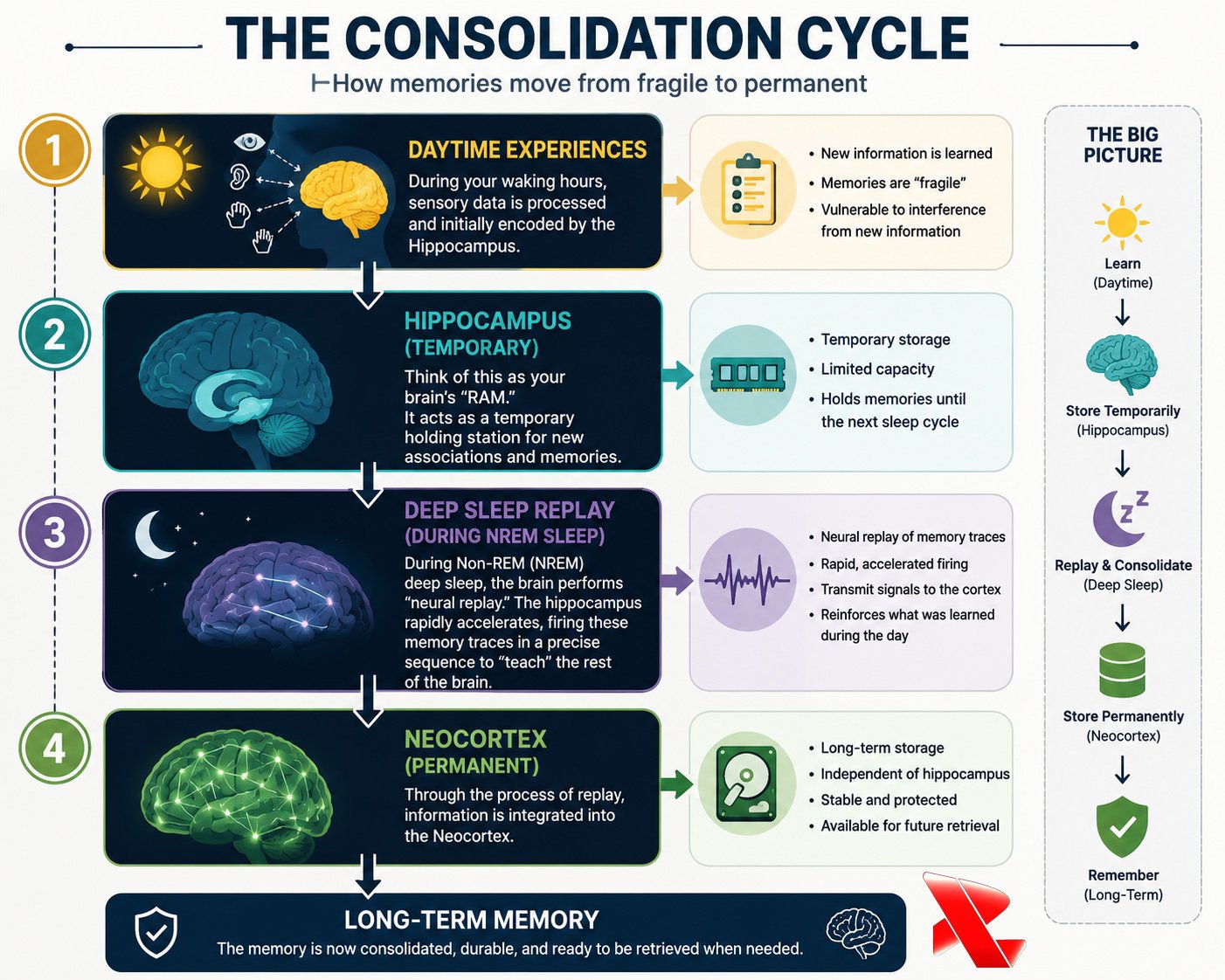
Sleep is the ultimate architect of human memory. During the day, your brain records fleeting experiences in the hippocampus, which acts as a temporary storage drive.
During sleep, the brain initiates a "replay" loop. The hippocampus reactivates the day's data and systematically transfers it to the neocortex for long-term storage. Without this crucial transfer process, your ability to retain new information drops significantly, making learning new skills or retaining daily facts incredibly difficult.
3. REM Sleep: Nature's Overnight Therapy
While deep non-REM sleep cleanses the physical brain, Rapid Eye Movement (REM) sleep restores the emotional mind. Often described as a form of "overnight therapy," REM sleep provides a unique neurochemical environment.
During REM, your brain completely shuts off noradrenaline (a major stress chemical). This allows the brain to reprocess difficult, painful, or traumatic memories from the day in a perfectly calm environment. By reviewing these experiences without the accompanying chemical stress, your brain strips away the sharp, emotional edge of the memory, allowing you to wake up feeling emotionally regulated.
4. The Biological Architecture of Sleep
Your optimal sleep pattern is largely dictated by your genetics. The PER3 gene determines your chronotype—whether you are naturally an "early bird" or a "night owl."
Psychology and circadian biology reveal distinct differences between these groups:
| Chronotype | Genetic Tendency | Common Psychological Strengths |
| Early Birds | Advance Circadian Phase | Higher proactivity, higher scores in agreeableness. |
| Night Owls | Delayed Circadian Phase | Higher scores in creative thinking and divergent intelligence tests. |
The "First Night Effect"
Have you ever wondered why you wake up exhausted after staying in a new hotel room? This is known as the First Night Effect. Mirroring the survival instincts of marine mammals and birds, the left hemisphere of the human brain remains slightly more alert than the right hemisphere during an unfamiliar environment. It acts as an evolutionary "night watchman," staying vigilant against potential predatory threats.
5. The Social and Threat-Simulation Cost of Sleep Deprivation
Failing to secure quality sleep carries steep evolutionary and social penalties:
-
Impaired Social Intelligence: Sleep deprivation directly degrades the amygdala's communication with the prefrontal cortex. As a result, sleep-deprived individuals struggle to distinguish between friendly and threatening facial expressions, frequently leading to misinterpretation of social cues, increased anxiety, and social withdrawal.
-
Dreaming as a Virtual Reality Simulator: Evolutionary psychologists hypothesize that dreaming functions as a Threat Simulation Theory (TST) mechanism. By simulating fight-or-flight scenarios in a risk-free dream state, the brain biologically rehearses threat-response strategies, ensuring you are better equipped to handle real-world emergencies.
Optimizing your sleep is not merely about beating morning fatigue; it is a fundamental pillar of biological survival, neurological cleanliness, and emotional intelligence.
Optimizing Your Sleep: Quick Actionable Steps
-
Prioritize Light Timing: View bright sunlight within 30 minutes of waking to anchor your circadian rhythm via the PER3 gene pathway.
-
Keep It Cool: Drop your room temperature to roughly 18°C (65°F) to mimic the natural core body temperature drop required to initiate deep sleep.
-
Guard the Final Hour: Eliminate blue light emitting screens 60 minutes before bed to allow natural melatonin production to peak.
Disclaimer
The information provided in this report is for informational and educational purposes only. It should not be construed as medical advice, diagnosis, or treatment. Always seek the advice of your physician or other qualified healthcare providers with any questions you may have regarding a medical or neurological condition.


